June 22, 2026
Esports tournaments can pack in as many as fifty teams, but only one ends the bracket as champions. Organizers pick from a handful of formats to get there, with team count, event size, and esports tournament operations all shaping the choice. Here’s a rundown of the most popular tournament models and how they work.
No two tournaments are run quite the same way. A regional qualifier with sixteen teams looks nothing like a season-long league or a major LAN final, and the format an organizer picks shapes everything from match pacing to which teams realistically have a path to the trophy. Some reward consistency over weeks of play, others come down to a single elimination match.
These choices depend on many factors, including team availability based on location, if the format is heavily LAN-based, team count, time frame, etc.
What’s an esports tournament format?
A format is the framework that decides what competitive infrastructure looks like; how teams are paired, how matches are scheduled, and what it takes to win or get eliminated.
For example, if 50 teams register for a Valorant event, an admin would set up their matches based on the format they prefer. If they pick a single elimination, Bo3 format, each team will get only one shot at making it to the next stage. But that single shot will include three Valorant maps due to the Bo3 model.
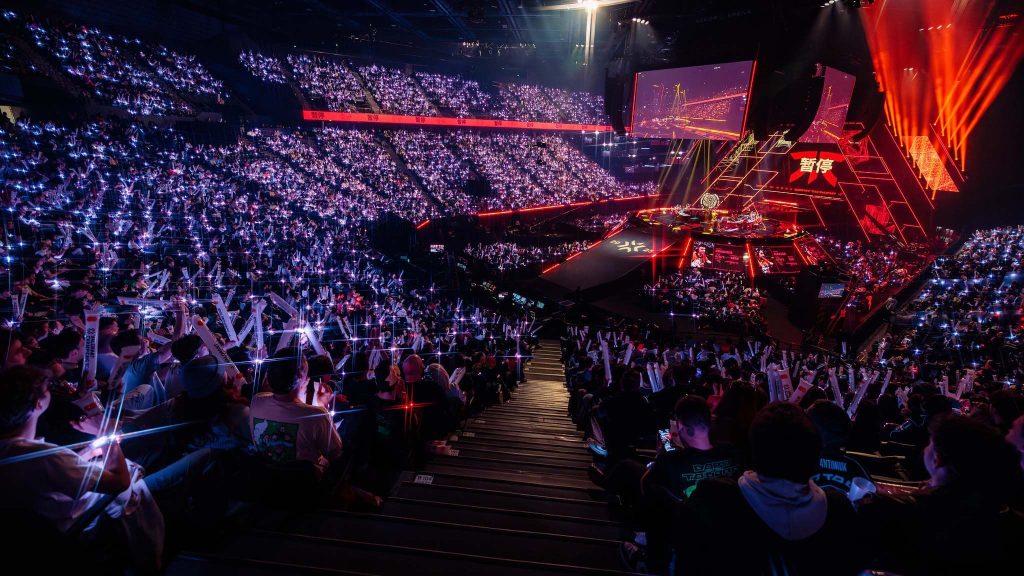
Bo3 here stands for best-of-three, and while it’s not necessarily a model, it does quite a lot of heavy lifting. It simply means a match is decided by winning two out of three games rather than a single round. You’ll also see Bo5 (best-of-five, first to three wins) in grand finals, and Bo1 (a single game) in early rounds where speed matters more than certainty
Sometimes, admins would pick a tournament format simply because it’s better at giving all teams a fair shot at proving their mettle. Other times, that choice comes down to game type. Some games simply don’t allow for certain formats to work.
For example, a game like Dota 2, where a single match can run upwards of forty minutes, doesn’t lend itself to large single-elimination brackets in the way a faster game might. Long match times push organizers toward formats like Swiss or group stages, which give teams multiple games to prove themselves without dragging the schedule out across weeks.
What are all the esports tournament formats?
In 2026, event organizers will use different esports tournament formats, some inspired by traditional sports and others that work strictly in esports. Whether you’re an aspiring pro player or someone hoping to get into esports in general, understanding how formats work is crucial to truly enjoy an event even as an online viewer.
Here are some of the most common esports tournament formats and how they work.
- Single Elimination
- Double Elimination
- Swiss System
- Round Robin
- League / Season Format
- Battle Royale Points Format
Single Elimination
Single elimination is the simplest tournament format in esports. Teams are placed into a bracket, and every match is a knockout, which means you lose once, and you’re out. The bracket halves with each round until two teams meet in the grand final.
Typically, small-scale events with limited budgets and time use single-elimination formats. You’d rarely ever see esports giants like Dota 2 or League of Legends design their entire major series around the single-elimination format. However, this format does come into play in later stages of an event, once teams have been filtered out.
You’ll see it most often in the playoffs of major events rather than as a standalone format.
The League of Legends World Championship runs single elimination from the quarterfinals onward, and the Valorant Champions Tour uses it for several stages of its Masters and Champions playoffs.
Double Elimination
Double elimination splits the field into two brackets: an upper bracket and a lower bracket, also known as winners’ bracket and losers’ bracket. Lose in the upper, and you drop down to the lower bracket for a second chance. Lose in the lower, and you’re out. The two bracket winners meet in a grand final, often with the upper bracket finalist holding a one-game advantage.
This is a popular format in CS2, but again, you won’t see it as a standalone method to filter out the best teams. Dota 2’s The International has run double elimination playoffs since 2012 and is the format’s most prominent example. Fighting game majors, EVO across Street Fighter, Tekken, and Guilty Gear, also run double elimination almost universally, because individual matches are short and a single bad read shouldn’t end a top player’s tournament.
Swiss System
Swiss System is the format that’s heavily been used in round-based shooters, especially CS2. It is a points-based format borrowed from chess. Every team plays a fixed number of rounds, but instead of a bracket, teams are matched each round against opponents with similar win-loss records. Wins advance you toward qualification; a set number of losses eliminates you.
The Counter-Strike 2 Majors run their opening Challengers Stage and Legends Stage on Swiss, and it’s now the standard for sorting twenty-four-team CS2 fields down to the eight teams that advance to playoffs.
Strategically, Swiss rewards consistency over peak performance: a team that goes 3-2 across five rounds is treated equivalently regardless of how those wins and losses are distributed. Teams also have to prepare for a wider range of opponents, since their next match depends entirely on their last result.
Round Robin
Round robin is the most thorough format in esports. Every team in a group plays every other team, with standings determined by total wins and losses.
This is the format of choice for group stages where fairness is the priority. It’s used in the group stage of League of Legends Worlds, Dota 2 Majors, and most Valorant international events.
The strategic identity of round robin is comfort with variance. Teams can afford to experiment, drop a match, and still recover, which often produces more diverse drafting and stylistic risk than knockout formats.
Hybrid format
Most event organizers design a format that is a mix of all to give teams a fair shot without dragging a tournament. The pattern is consistent across nearly every major event: a sorting format up front, a narrowing knockout in the middle, and a high-stakes final bracket to crown the champion.
Overwatch’s Calling All Heroes 2026 is a clean example of how this layering works in practice. The competitive circuit, designed to create a more inclusive path into professional Overwatch esports for women and players of marginalized genders, runs its full season across three distinct format phases.
The regular season uses a Swiss system, with up to 64 teams playing six rounds across three weekends. Swiss is the right call here for the same reason CS2 Majors use it: it handles a large field efficiently and pairs teams against opponents of similar records, so the standings at the end of the rounds reflect actual performance rather than bracket luck.
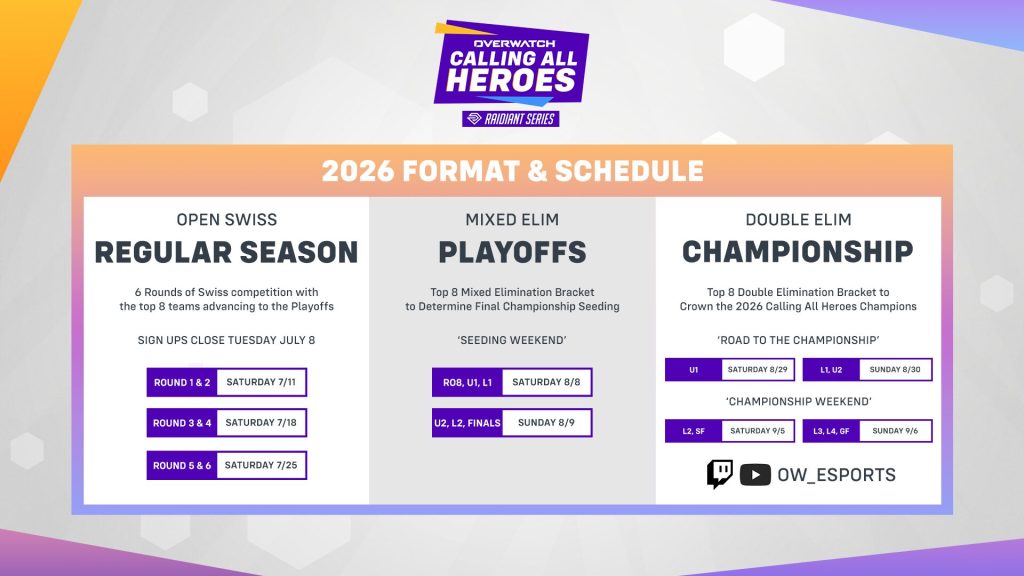
The playoffs shift into single elimination for the top eight, then transition to double elimination for the final four. Finally, the championship runs as a full double-elimination bracket, with all eight playoff teams competing for a share of the $40,000 prize pool.
That three-stage progression is essentially the same template used by the largest events in esports, scaled up or down depending on the field size and the length of the event.
Battle Royale Points Format
Battle royale games can’t fit into traditional bracket play. With sixty or more players in a single lobby and only one winner per match, you can’t run a 1v1 or 5v5 bracket. The format itself has to be different.
The solution is a points-based system across multiple matches. Teams play a series of games and earn points for placement and eliminations. Final standings are determined by cumulative points across the full set of matches. Some events run multiple lobbies in parallel, with teams rotating between lobbies to balance the competition.
The Apex Legends Global Series uses this format throughout its circuit, as do the Fortnite Champion Series and the PUBG Global Championship. Strategically, point formats push teams toward consistency rather than swinging for one big finish.