September 15, 2026
There is a version of competitive gaming that looks exactly as it should: players showing up, putting in the work, and getting better over time. And for many women in esports, that version exists. But alongside it is a darker side that can shape whether a player keeps going or quietly steps away, never wanting to look back.
The pressure to perform in competitive esports is real for everyone, yes; but for women, that pressure rarely arrives on its own. Esports has long been a predominantly male space, and women entering that scene often face a different kind of scrutiny: online abuse, sexual harassment, assumptions about their ability, and the exhausting feeling that they have to prove they belong before others take their gameplay seriously.
That adds a layer of pressure that can be difficult to see from the outside, but can have a real impact on whether someone feels welcome enough to stay. It’s a cost that doesn’t get talked about enough, and one of the reasons why creating safe spaces for women in esports isn’t just a nice idea. It’s a necessity.
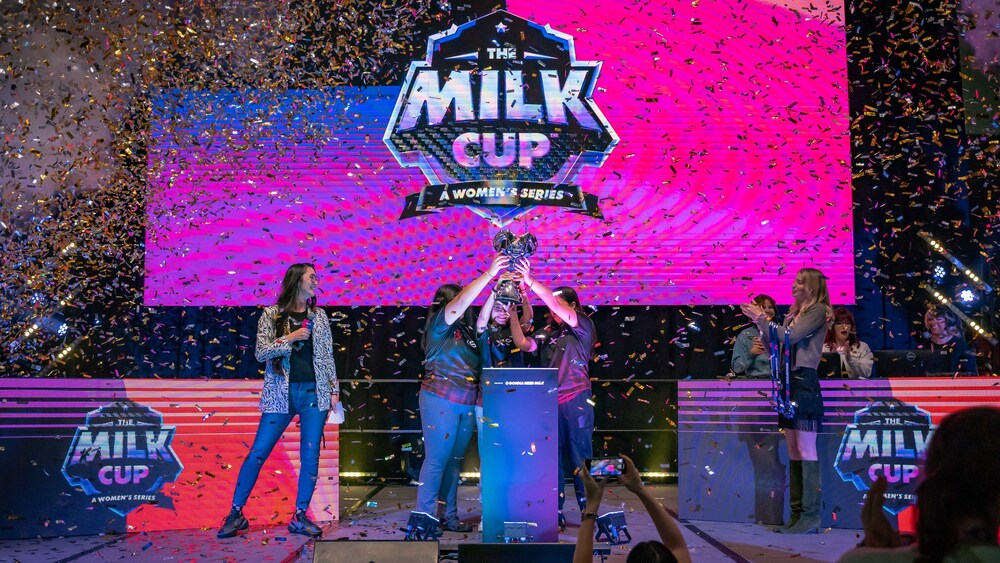
That’s something Raidiant has understood from the start. Programs like Calling All Heroes, Raidiant Academy, and The Milk Cup are about creating opportunities and environments where women can actually compete without carrying all of that extra weight. But to understand why that matters, it helps to understand what women in esports are actually up against.
Harassment is not a minor problem
Women make up nearly half of gamers worldwide. Bryter’s 2025 Women Gamers Study estimates that women make up around 48% of gamers worldwide. Its latest report, based on more than 1,000 PC and console gamers in the US and UK, also found that one in three women surveyed still experienced toxicity regularly, with the highest levels reported among women aged 16 to 24.
A survey commissioned by Sky Broadband questioned 4,000 British gamers and found that 49% of women had experienced abuse or harassment while playing or streaming online. Among women aged 18 to 24, that figure rose to 75%. More than half said they worried about abuse while gaming online, while 31% reported lying about their gender or remaining anonymous during gameplay. The problem is not just that competitive games can sometimes be toxic. Women are also disproportionately targeted because they are women.
The Anti-Defamation League’s 2023 nationally representative US survey of online multiplayer gamers found that 48% of women reported being harassed because of their gender, and Kinsey Institute researchers reported that 56.6% of North American women gamers had experienced at least one form of sexual harassment during online play. Almost half had also witnessed sexual harassment directed at another woman.
A 2026 study on competitive women, transgender, and gender diverse gamers found that around 87% reported gender-related harassment and had developed avoidance strategies specifically to minimize it. Research found that gender masking is still common among women in amateur esports (players changing usernames, avoiding voice chat, or stripping any gender cues from their text just to get through matches with less abuse). So harassment doesn’t just affect someone’s experience of a match; it can also shape how comfortable they feel making themselves visible within competitive gaming, potentially affecting their ability to build the kind of presence that can actually lead somewhere.
The pressure of visibility
For women who do push through and compete publicly, there’s a different kind of weight waiting for them: the pressure that comes with being visible in a space that still treats you as an exception.
Even when women aren’t dealing with direct harassment, they’re still navigating heightened scrutiny and uneven expectations. If a woman performs poorly, there will be people ready to use it as proof that women don’t belong in high-level competition at all. And the attention from supportive fans, however well-intentioned, still places extra pressure on competitors who now feel they have to perform exceptionally just to justify their place there. That’s a mental load that male players don’t carry in the same way. Every match is played with that backdrop running. And over time, that accumulates.
Research suggests that this kind of environment has a measurable psychological cost. The 2026 Nottingham study found that women and gender-diverse competitive gamers who had experienced harassment reported significantly more anxiety, stress, depression, and gaming imposter syndrome than those who had not. They were also more worried about participating in both online and offline gaming communities.
That sits on top of pressures already present across esports. A 2025 study of more than 15,000 esports competitors found that newer generations of players are experiencing markedly shorter careers, with intense training, early specialisation, exploitative practices, and weak industry structures among the factors researchers linked to burnout and rapid turnover. Those pressures affect esports players broadly. But for women already dealing with gender-based harassment and the extra scrutiny that comes with being visible, they don’t exist in isolation.
The result, for many, is that they stop. Quietly. One tournament at a time, one ranked session at a time, until competing no longer feels worth what it costs.
The structural problem behind the personal toll
It would be easy to treat this as a collection of individual bad experiences. But there’s a pattern behind it.
A 2021 study of 5,607 Norwegian adolescents found that gaming was considerably more socially accepted among boys and that girls reported feeling less encouraged to play because of gender-related experiences around gaming. It’s a boys’ activity in a way that it increasingly isn’t for everyone else, and that social pressure can shape who feels entitled to invest time in developing gaming skills and who doesn’t. By the time some women decide they want to compete, they may have missed years of early exposure and practice that male peers were more likely to be encouraged to build from childhood.
Then when they do enter competitive spaces, they enter environments that weren’t built with them in mind. Voice chat becomes a risk calculation. Streaming publicly invites a different kind of attention. Female-only competitive spaces are still a small part of the overall esports ecosystem, and the open brackets that are technically available to everyone are, in practice, not equally accessible to everyone.
And there is another psychological mechanism worth considering: stereotype threat.
In a 2016 experiment, researchers tested whether activating negative stereotypes about women’s gaming ability could affect performance. Women exposed to stereotype threat underperformed relative to male participants in the control condition, while an intervention that encouraged participants to think about multiple positive social identities helped protect against that effect. It was a relatively small experimental study, so it shouldn’t be treated as proof that stereotypes explain every performance gap in gaming. But it demonstrates that the environment surrounding a player can affect what happens in the game itself.
And underneath it all runs something that research is only recently starting to examine more directly: gaming imposter syndrome. A 2026 study of competitive women and gender-diverse gamers found high levels of imposter feelings among participants, alongside experiences of gender-related harassment and avoidance behaviours. The researchers connect these experiences with the psychological strain of navigating discrimination and identity-based stress. It’s not a personal failing. When you’re repeatedly made to question whether you belong, it’s not surprising that some of that doubt eventually becomes internal.
Progress shouldn’t require being exceptional
But things are changing. Slowly, and probably not nearly as quickly as they should, but they are changing. Gaming is more widespread than ever and increasingly understood as something for everyone. More women are competing, more women are visible in esports, and more tournaments and competitive spaces are being created specifically for women.
But we also need to be careful about how we talk about that progress. When a girl or woman performs well, we shouldn’t always frame her as an amazing exception (as if the fact that a woman can be genuinely good at competitive gaming is remarkable in itself). The more we present women players as exceptions, the more we reinforce the idea that being a woman in competitive gaming is something unusual and difficult to achieve. That can make the next girl looking at the scene feel like she has to be extraordinary just to be there.
Yes, becoming good at a competitive game takes work. It takes time, practice, dedication, and probably a lot of losing before you start winning. But those things aren’t uniquely male. Being a woman shouldn’t make competitive gaming feel like an achievement we have to earn permission to attempt. It should be something that’s within our reach.
That gap between technical access and actual access is where a lot of talent can still get lost. Players who could have developed into something extraordinary may step back instead, because the environment asks too much of them before they’ve even had a chance to figure out how good they might be.

Why supported spaces can change the outcome
Women in esports tournaments created specifically to support women and marginalised genders are sometimes dismissed as separate leagues that exist because women supposedly can’t compete elsewhere, and that completely misses the point.
An open tournament can technically allow everyone to enter, while the pathway required to reach it remains very different depending on who you are. If voice chat regularly exposes you to harassment, practice gets harder. If unfamiliar teams make you wonder whether your gender will affect how seriously teammates take you, finding a stable roster gets harder. And if visibility brings attention other competitors don’t have to manage, building a public competitive profile gets harder too.
The Games and Culture study on women in amateur esports found that, alongside experiences of exclusion and sexism, participants described solidarity between women and visible female role models as sources of support. Its researchers specifically suggested gender-focused tournaments, teams, and communities as places where women can meet people and develop their skills, while stressing that those spaces shouldn’t become limits on where women are allowed to progress.
The 2026 Nottingham study reached a similar conclusion. Women and gender-diverse participants viewed identity-specific gaming communities positively and reported that they would feel more comfortable participating socially and competitively within them.
Women-focused spaces should help players build experience, confidence, connections, and competitive history, but they shouldn’t become the only place women are expected to compete. The goal has to be a wider esports ecosystem where women can move from those supported environments into mixed competition, trial for established teams, and be evaluated fairly.
Supported spaces should be a bridge, not a ceiling
Research into women’s experiences in esports has also documented cases of direct gender-based exclusion. In the Games and Culture study, one participant described successfully progressing through a team trial before being told that the roster simply did not want a woman on the team. Another recalled a mixed-gender team being split by gender after a male teammate directed sexist comments at her, rather than the organisation addressing the person responsible for the behaviour.
So creating women-focused tournaments is a good step forward, but it cannot be the final answer to exclusion. If every time a woman encounters hostility the solution is to move her into a separate space, the barrier hasn’t really been removed. She’s just been moved around it.
Supported spaces are valuable because they give more players a fair chance to develop without carrying every additional barrier at once. But the long-term measure of success should be whether those players can leave those spaces when they want to and try to prove themselves in the wider competitive ecosystem without their gender becoming an obstacle.
That means making mixed teams and open competition more accessible too: taking harassment seriously, challenging assumptions about women players, and making sure women are given the same opportunity to prove whether they fit a roster. Competitive ability isn’t everything; communication, trust, and team chemistry matter too, yes. But women should have the same chance to prove that fit and not be treated as a disruption by default.
And that means working with the players already inside those environments too. Inclusion cannot depend entirely on women learning how to adapt to male-dominated teams. Teams, coaches, organisations, and players also need to recognise how stereotypes and existing social dynamics can influence who feels welcome and how someone’s ability is evaluated.
What gets lost when women leave
Every player who steps away because competing becomes too exhausting represents experience, skill, ambition, and maybe even a future career that never gets the chance to develop. We may never know how many talented women esports has already lost that way.
But if the industry wants to keep growing, creating more opportunities is only part of the answer. It also has to make sure people can stay long enough to use them.
Talent means very little if the environment pushes it out before anyone gets to see how far it could go.