September 7, 2026
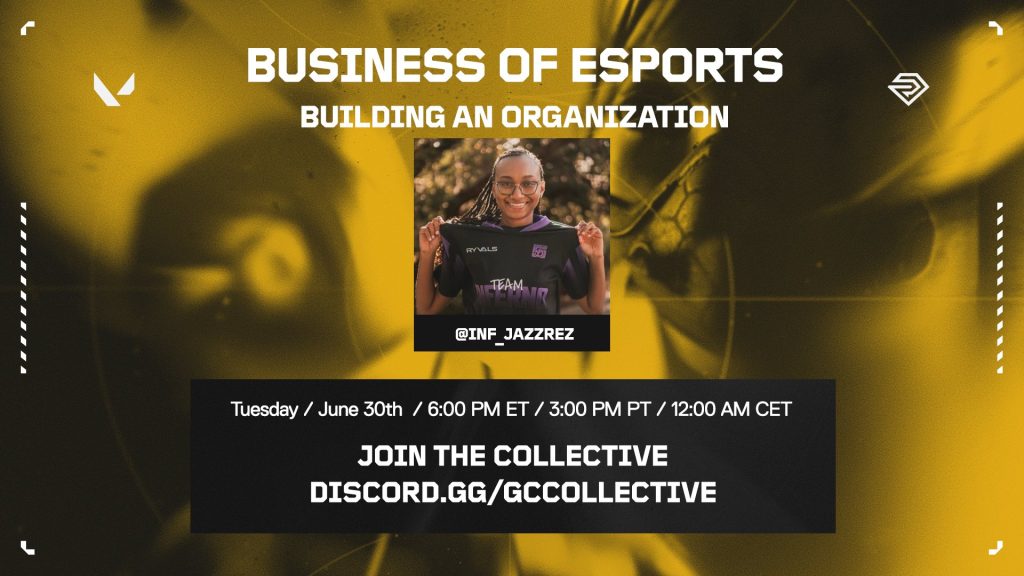
Most esports organizations are not profitable, by the founder’s own account, most never will be under the model the industry defaults to. That was the blunt premise Jazzrez, founder of Team Inferno, laid out on this week’s Tactical Tuesday.
Five years ago, Jazzrez put her personal Apex Legends and Warzone content-creator logo on some merchandise. A fan in her community asked a simple question: “How do you have jerseys but no team?” Jazzrez didn’t have an answer, so she opened applications for an Apex Legends roster. Over 3,000 people applied.
“I was like, okay, like clearly we can do something with this,” she said. “And that literally spawned Team Inferno.”
That accidental origin story kicked off this week’s Tactical Tuesday, the Game Changers Collective’s recurring series pairing marginalized creators and org leaders with the community for candid conversations on the business side of gaming. Team Inferno, now a Charlotte-based, EA-licensed tournament host that’s paid out more than $30,000 in prize money, sat down to talk through five years of building an org from a Discord server into a company, and what it actually takes to keep an esports business alive.
A mission born from lived experience
Team Inferno’s tagline “community, first,” isn’t marketing gloss. Jazzrez traced it directly back to her own path through the industry.
“My personal experiences as a black woman in gaming led to the actual mission behind Team Inferno, which is creating a safe space for marginalized communities and increasing our representation in gaming,” she said. “Those two things combined really gave us the vision for Team Inferno’s future.”
The org celebrated its fifth anniversary in May, and last year the Apex Legends roster finally qualified for ALGS Pro League, a milestone Jazzrez pointed to as the moment the team’s identity grew into what it is today.
“That was kind of the moment that made us realize there’s more that we can do that’s not really typical for an org,” she said. “So it’s kind of shifted over time… we’re a community first, we’re not competitive first.”
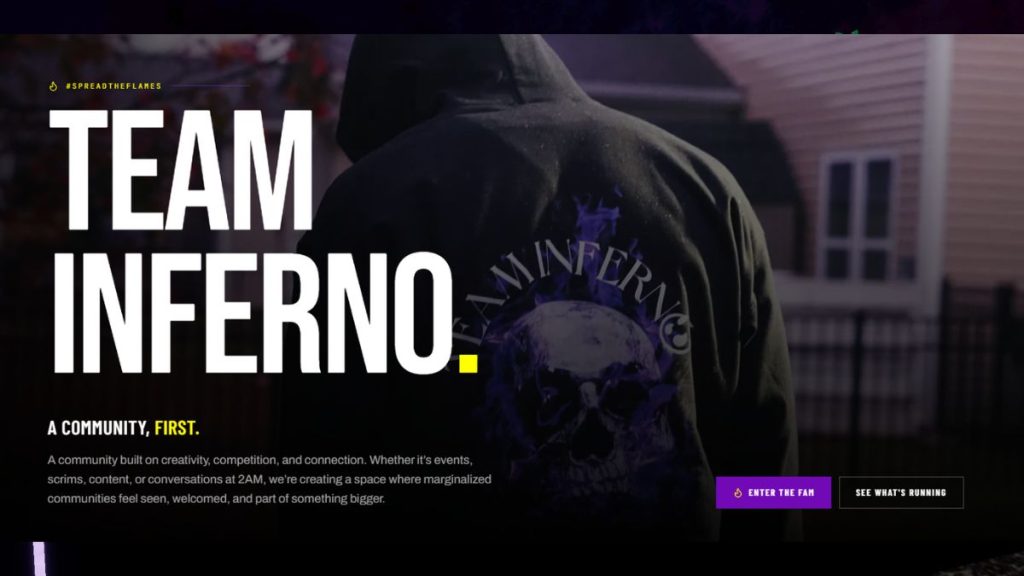
Rather than chase a marquee competitive roster the way most orgs do, Team Inferno leaned into community nights, party-game sessions, and its monthly Blaze Cup series, and Jazzrez was candid about why.
“As much as I love [competing], it’s not something I want to stop doing, but you can kind of get caught up in the performance of it,” she said. “If you do have a team that’s winning and then suddenly they’re not winning, you can feel the shift in the community when that’s the main focus. But things like events don’t have the same level of pressure… it’s not necessarily winning or losing in the same way that a competitive team would.”
It’s also a fandom strategy. As the host put it during the session, building around events builds “fans of the whole organization, not fans of the players” because rosters turn over and players get poached, but a community event keeps happening regardless.
Asked point-blank how esports orgs actually sustain themselves, Jazzrez didn’t sugarcoat it.
“That’s such a funny question to me because most of the orgs don’t sustain themselves. They are not profitable. There’s very few that are,” she said, citing T1 and Team Liquid as recent exceptions. “Even if they’re profitable today, which is great, they’re actively digging out of the hole that they’ve been in for years.”
That tracks with the broader industry picture: T1 reported its first profitable year since its 2019 relaunch in 2025, with revenue topping $60 million after years of losses, and Team Liquid’s ownership has similarly pointed to 2024 as one of its strongest financial years on record, both are the kind of exceptions Jazzrez was describing, not the norm.
Her diagnosis for why so many orgs struggle: over-reliance on a small number of sponsors. “I think last time I looked it was like 70 or 75% of org revenue is from sponsorships. That’s a really volatile thing,” she said. “If you have like ten sponsors, okay, you’re probably fine. But for the ones that have two to three that are the bulk of their income. Once that partnership ends, if they don’t want to renew, I don’t know what to tell you.”
Team Inferno’s answer was to make its own recurring revenue instead of waiting on brand budgets. The org built out a paid membership model, originally through Patreon, now folded into its own site, that started as something almost accidental: because Apex Legends lobbies cap at 60 players, Team Inferno’s self-hosted scrims routinely had more teams on the waitlist than could get a slot.
“People wanted to pay for priority so that they could guarantee their spot,” Jazzrez said. “Being able to create monthly recurring revenue in a way that relies on just our ability to host rather than a sponsorship… was pretty much game-changing for us. It gives a lot more independence. You don’t feel like you’re at the mercy of another brand.”
Today, she said, events generate revenue “near equivalent” to sponsorships for Team Inferno; a split she called a point of real pride.
Getting sponsors to actually say yes
On landing sponsorships in the first place, Jazzrez’s advice broke from the usual playbook. Cold decks and generic outreach rarely move the needle, she said, because “there’s literally a trillion orgs, a trillion creators” all pitching the same “we want to win” mission.
“What’s gotten me to stand out the most is meeting them in person at events,” she said. “At least 80% of our sponsorships have come from me just meeting someone in person,” often at an afterparty or a more intimate side conversation, not the main event floor.
Her more surprising tip: LinkedIn, not Twitter/X, has been her most effective digital channel for reaching partnership managers. The approach she described was deliberately short: “who you are, what you’re building, and how it’s unique,” closed with a simple ask for a call, a contrast to the “wall of text” she admitted she used to send.
For anyone looking to start an org, or any business in gaming, Jazzrez’s starting point wasn’t funding or contracts, but market validation. “Figuring out what the need is in the market is essential,” she said. “If the people aren’t looking for what you’re offering, it’s going to be a really big uphill battle.” And if the space is already crowded, she said, study what people don’t like about existing options before trying to compete in it.
She pushed back directly on the idea that esports orgs are inherently a “money pit”: “Well, yeah, if you’re going to keep doing the things that make esports a money pit, then it’s going to be a money pit. You can do different things.”
Jazzrez closed the session by pointing people toward Team Inferno’s open applications for players, creators, and staff (currently prioritizing marketing and tournament-ops roles) at teaminferno.gg, and previewed the org’s upcoming Embers economy, which is a loyalty-points system where fans earn “embers” for engagement that unlock shop rewards and a visible rank tied to a flame-color system.
Watch the full Tactical Tuesday session, hosted by the Game Changers Collective, here: YouTube VOD