August 28, 2026
Women are 48% of gamers worldwide, but just 33% of esports viewers and 5% of on-air talent. The 2025 data suggests that the gap is all about who’s in the booth.
On paper, 2025 looked like a down year for women’s esports: total watch time fell 7.9%, and the number of dedicated tournaments dropped by more than half. But average concurrent viewership actually rose, and the year closed with a record $3.3 million in combined prize pools. That’s not an audience walking away. Instead, it’s an audience concentrating around fewer, better-produced events.
That means that the tournaments that survived the cut were disproportionately the ones with real broadcast infrastructure behind them. Those events also happen to be the ones setting records. VALORANT’s Game Changers Championship generated a $1.88 million media value this year, the highest of any women’s tournament. MLBB’s EWC Women’s Invitational drew nearly 497,000 peak viewers, the largest single peak in female esports for the year.
Together, VALORANT and MLBB account for roughly 86% of all women’s esports viewership, per Esports Charts’ 2025 report. It’s not a coincidence that both circuits are run through dedicated, professionally staffed broadcast operations rather than bolted onto men’s programming.
A case study in broadcast-first strategy
Raidiant is one of the operators building that infrastructure specifically for women’s competition. Founded as a division of New Meta Entertainment, which also owns the esports org Dignitas, Raidiant describes itself as the leading women’s esports broadcast operator, under the tagline “By Women, for Everyone.” Production is led by Heather “sapphiRe” Garozzo, an Emmy-nominated producer and Esports Hall of Famer, alongside live producer Alexis “pinecone” Wood.
Since 2024, Raidiant has been the official tournament partner for Verizon VALORANT Game Changers North America, running all three seasonal series plus Raidiant Academy, a lower-stakes developmental circuit built to widen the competitive pipeline before players reach the main stage.
The structure shows up in the numbers: the 2023 Game Changers Championship drew 294,000 peak viewers, the second-most-watched women’s esports tournament that year, and Raidiant’s 2025 NA seasons (Stage 1: 10,047 peak, 265,132 hours watched; Stage 2: 11,482 peak, 252,448 hours watched) have sustained that audience at the regional level even as the sport’s global championship draws far larger numbers.
In a 2024 interview with esports.gg, Garozzo tied that structure directly to viewership growth, describing the strategy as building “events that are a low barrier to entry, where you feel welcomed.” The logic being that a larger, more visible competitor pipeline eventually produces a larger audience pipeline. Whether or not that causal chain is fully provable, the data lines up with it: the circuits investing in both broadcast quality and pipeline-building are the ones outperforming the category’s overall contraction.
Raidiant’s production work extends beyond Valorant. Alongside GonnaNeedMilk and ThePeachCobbler, the studio produces The Milk Cup, the marquee women’s Fortnite tournament backed by MilkPEP. The event has scaled fast: its 2025 Finals, held at the San Diego Convention Center, carried a $210,000 prize pool and drew 36,898 peak viewers across 194,651 hours watched, building on a 2024 Finals that peaked even higher, at 57,607 concurrent viewers.
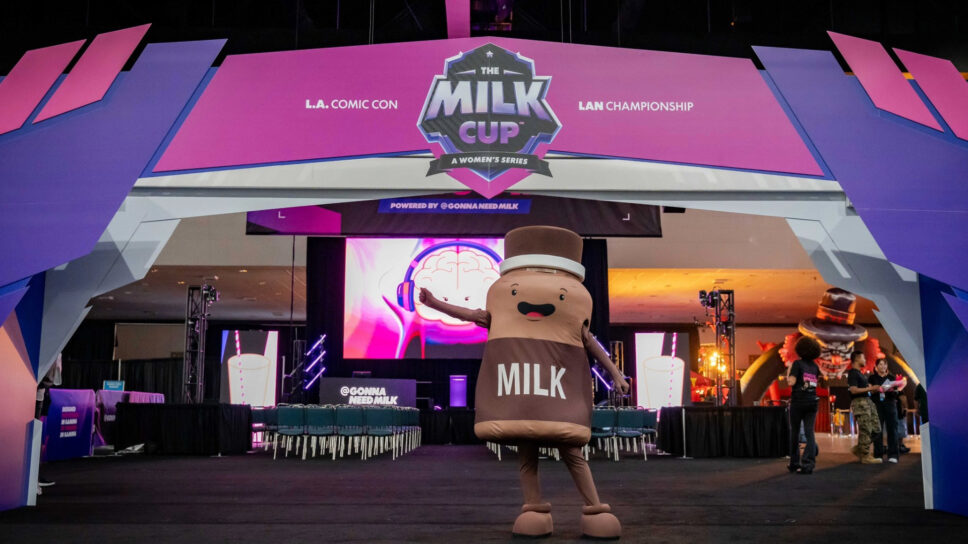
A regional 2025 qualifier alone pulled average concurrent viewership above 18,000. This was a strong number for a Fortnite qualifier by any measure, women’s or otherwise.
Across both circuits, the pattern holds: sustained investment in broadcasting, not just competitive quality, correlates with audience growth. The wider 2025 season backs this up structurally, too. Even as tournament counts contracted, Valorant and MLBB’s once-dominant 90%+ viewership share began giving ground to Counter-Strike 2, Arena of Valor, and others, alongside record prize pools.
Simply put, women’s esports isn’t short on audience appetite. The data suggests it’s short on the kind of broadcast infrastructure, Raidiant’s model among them, that turns appetite into a measurable, growing audience. None of this proves representation is the only lever. But it’s consistent enough to state plainly: when the booth reflects the audience it’s built for, that audience shows up. Production staffed by women isn’t a nice-to-have for women’s esports; it’s the variable most tied to whether women watch at all.